The popularity of AI-assisted coding tools has significantly changed many programmers’ coding habits. So, does this affect how frequently they use different programming languages? The latest data confirms: Yes, it does.
Recently, IEEE Spectrum released its annual “Top Programming Languages” ranking, marking the 12th consecutive year for this list. The results show Python remains the undisputed champion.
In the overall Spectrum ranking (weighted by IEEE member interest), Python has now topped the Spectrum list for ten consecutive years over the past decade, maintaining its #1 position this year without exception.
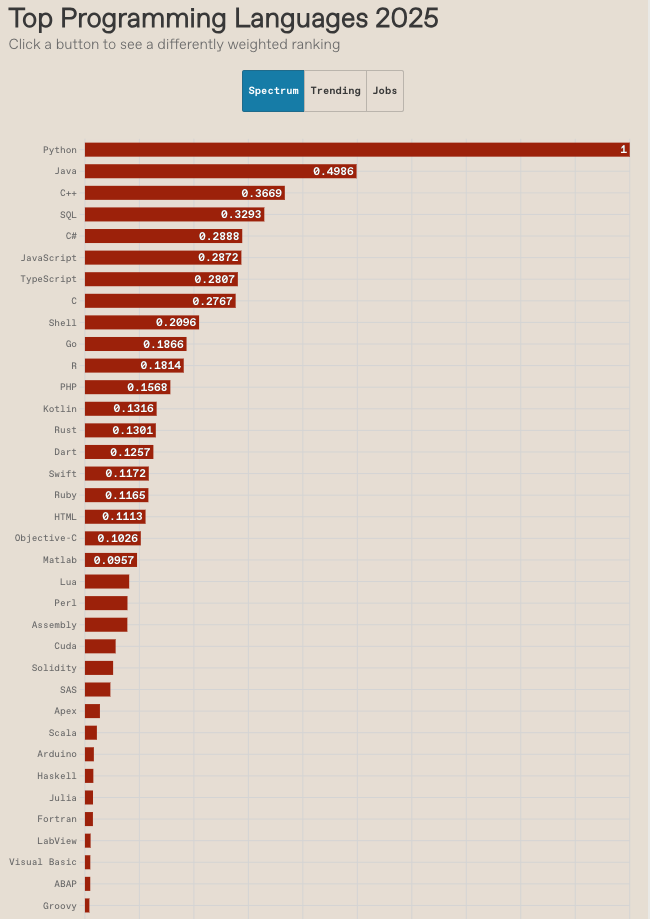
The most significant change this year belongs to JavaScript, which dropped from third place last year to sixth this year. Given that JavaScript has always been the “star performer” in web development, this relative decline in popularity likely relates to AI tools’ penetration into web development workflows. After all, with the rise of “Vibe Coding,” it’s frequently used by many technologists and enthusiasts for web development.
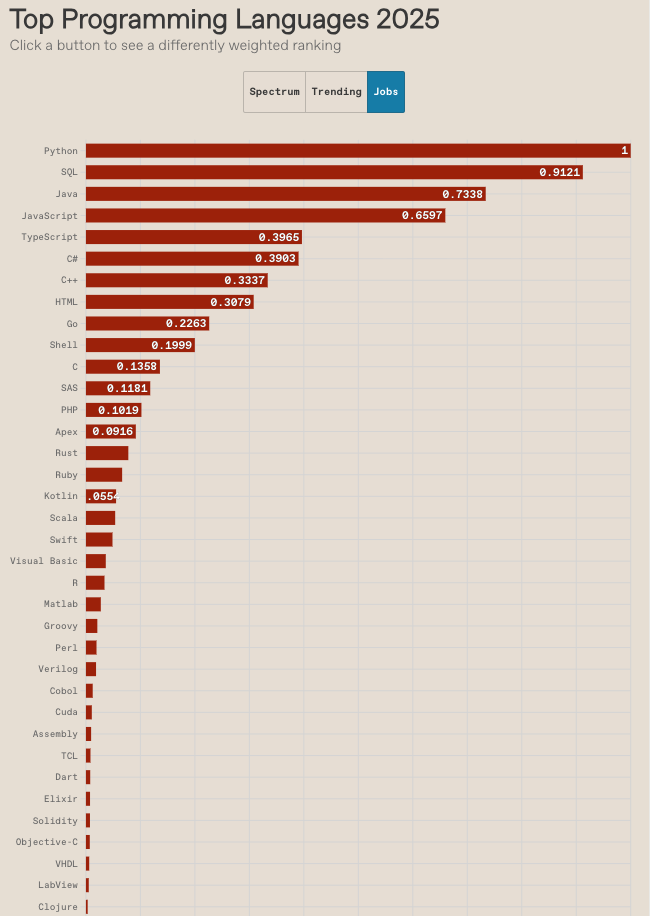
In the “Jobs” ranking (focusing more on actual employer demand), Python also achieved a milestone breakthrough: claiming the top spot for the first time, pushing SQL to second place. Despite this, SQL skills remain a significant resume booster, with employers still valuing them highly.
Looking at historical trends reveals even more interesting patterns. In the earliest rankings, Java, C, C++, and Python were almost neck-and-neck. In 2016, C briefly surpassed Java, while Python didn’t reach the top until 2017. At that time, the scores of major languages remained tightly clustered. Today, however, the gap has widened significantly: in the 2024 Spectrum ranking, Python scored 1, while Java only managed 0.4986 – a much larger disparity than ten years ago.
Some established languages are gradually fading. For example, Matlab, which ranked in the top ten in 2014/2015, dropped to 20th position this year, with its index falling from 0.724 to 0.0957.
From a broader data perspective, 19 languages this year scored above 0.1 on the Spectrum index, compared to only 15 last year. On the job demand ranking, only 13 languages exceeded 0.1. In terms of annual changes, JavaScript experienced the largest drop, falling from 0.4451 to 0.2872.
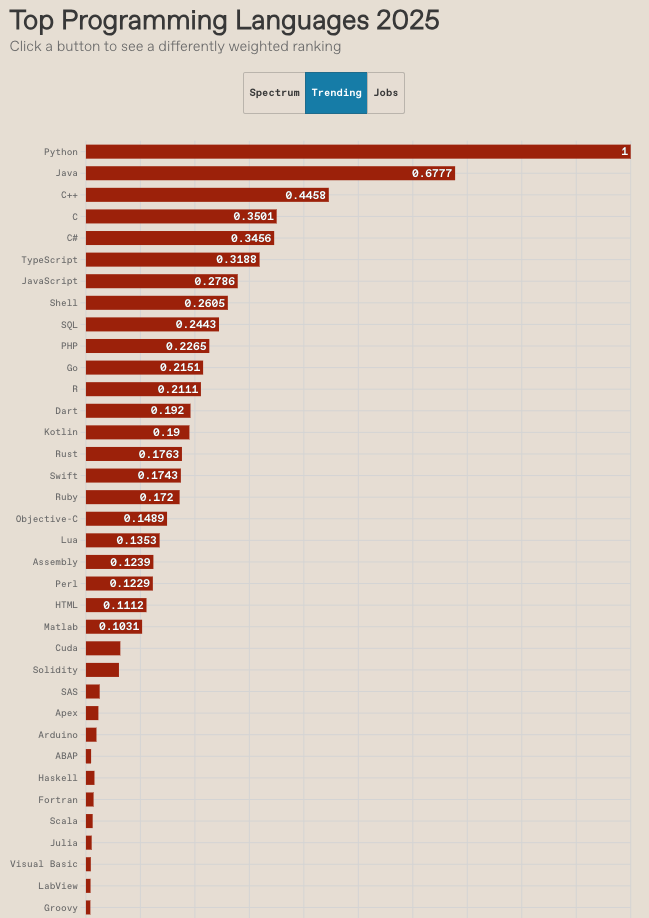
On the Trending ranking, Python continues to lead by a wide margin, with Java in second place (0.6777) and C++ in third (0.4458) – the gap remains substantial.
Regarding the ranking’s methodology: as in previous years, IEEE’s ranking combines data from multiple sources, including Google searches, GitHub activity, IEEE Xplore paper counts, and IEEE Career Builder job data. Different rankings use different weightings, with the “Job Demand” ranking being the most intuitive and closely aligned with the employment market.
However, IEEE officially interprets this trend: programmers today are relying less on these public metrics. Instead of consulting books or searching for answers on Stack Exchange, they’re increasingly having private conversations with LLMs like Claude or ChatGPT. With assistance from AI tools like Cursor, the need to ask questions during programming has significantly decreased. For instance, across all languages evaluated in TPL, the weekly number of questions posted on Stack Exchange in 2025 is only 22% of the 2024 volume.
The weakening of these public metric signals makes tracking cross-language popularity more challenging. Solutions include finding new metrics or attempting to directly survey programmers – regardless of their background and preferences.
However, a more fundamental issue is emerging. Whether it’s senior programmers using AI for repetitive tasks or beginners using vibe coding to complete full web applications, AI assistance means programmers are paying less attention to specific programming languages. From syntax details to flow control, function design, and overall program structure, more work is being handed over to AI.
IEEE believes the proliferation of AI-assisted tools will have an obvious long-term consequence: the emergence of new languages may become more difficult. In the past, new languages often started from ideas of individuals or small teams, gradually attracting contributors and users through continuous promotion. But today, many are questioning: will future programming languages develop in the same way as before?
To answer this, we need to revisit the original purpose of programming languages. The core mission of modern high-level languages essentially boils down to two things: helping programmers handle data more conveniently, and preventing programmers from making foolish mistakes. Neither goal is new. As early as the Fortran and Cobol era, languages began providing abstraction layers for scientific computing and business data processing. Later, Dijkstra’s 1968 paper sparked a “Stop Using Go To Recklessly” movement – arguing it created “spaghetti code” that others couldn’t understand. History proved his viewpoint correct, as most languages today have essentially “eliminated” Go To, replacing it with more structured functions, loops, and modules.
Interestingly, these structures don’t exist at the CPU level. In the instruction sets of Arm, x86, and RISC-V, program flow control has only three forms: conditional jumps, unconditional jumps, and return jumps. In other words, so-called structured programming ultimately still relies on “Go To.” The same applies to data types – while they appear rigorous, in memory they’re essentially just bit streams.
This raises a question: if AI programming assistants become sufficiently powerful, do we still need these abstractions and protection mechanisms? Some research already provides interesting answers. Princeton’s team developed a generative AI called Dall-EM that can directly design radio frequency and electromagnetic filters. This type of design was previously considered “black magic,” requiring expert debugging, yet Dall-EM can generate QR-code-like structures directly from inputs and outputs – configurations human engineers wouldn’t conceive of, but that perform well.
Drawing an analogy to programming, might future AI skip “human-readable high-level languages” altogether, translating prompts into intermediate languages before handing them to compilers? For humans, code might become a black box, yet still modularizable, testable, and verifiable for quality. At that point, programmers’ daily work might not involve fixing bugs, but rather refining prompts.
This doesn’t mean programmers will be completely replaced. Decisions still requiring human judgment include architecture design and algorithm selection: should path planning use A* or a new method? How should modules interface with larger systems? These are decisions AI cannot fully make autonomously.
In other words, what will become more valuable in the future isn’t how many lines of code one writes, but rather the ability to understand underlying logic and design systems well. Compared to “crash courses” on specific languages, fundamental computer science skills will become more important.
Based on this, IEEE itself posed a self-reflective question: Will there still be a “Most Popular Programming Languages” ranking in 2026? Their official response: Programming is undergoing its most significant transformation since the birth of compilers in the 1950s. Even if some dismiss AI as a bubble, history shows that every bubble leaves behind several truly useful things. AI coding assistance will likely be one of them.
Therefore, for future programming language rankings, we may need to reconsider: How should “popularity” be calculated? Should we still consider search volume and job demand, or simply track which types of prompts are most commonly used in AI tools?