Anyone who has actually taken a patient’s history or managed a complex case on the floor knows that diagnosis is never a static multiple-choice question. You start with incomplete information, talk to the patient, order scans, and adjust your thinking dynamically. Yet, when we architect and evaluate medical AI models, we mostly test them on static Q&A datasets.
A new paper published in npj Digital Medicine (2026) titled “AgentClinic: a multimodal benchmark for tool-using clinical AI agents” finally addresses this massive disconnect between static benchmarks and real-world sequential decision-making.
What AgentClinic Actually Means
The core finding of this paper is a wake-up call for health-tech engineering: static medical QA benchmarks dramatically overestimate an AI’s actual clinical competence. When researchers took standard MedQA problems and reformatted them into a sequential, interactive simulation, the models’ diagnostic accuracies dropped substantially, sometimes plummeting to below a tenth of their original multiple-choice score.
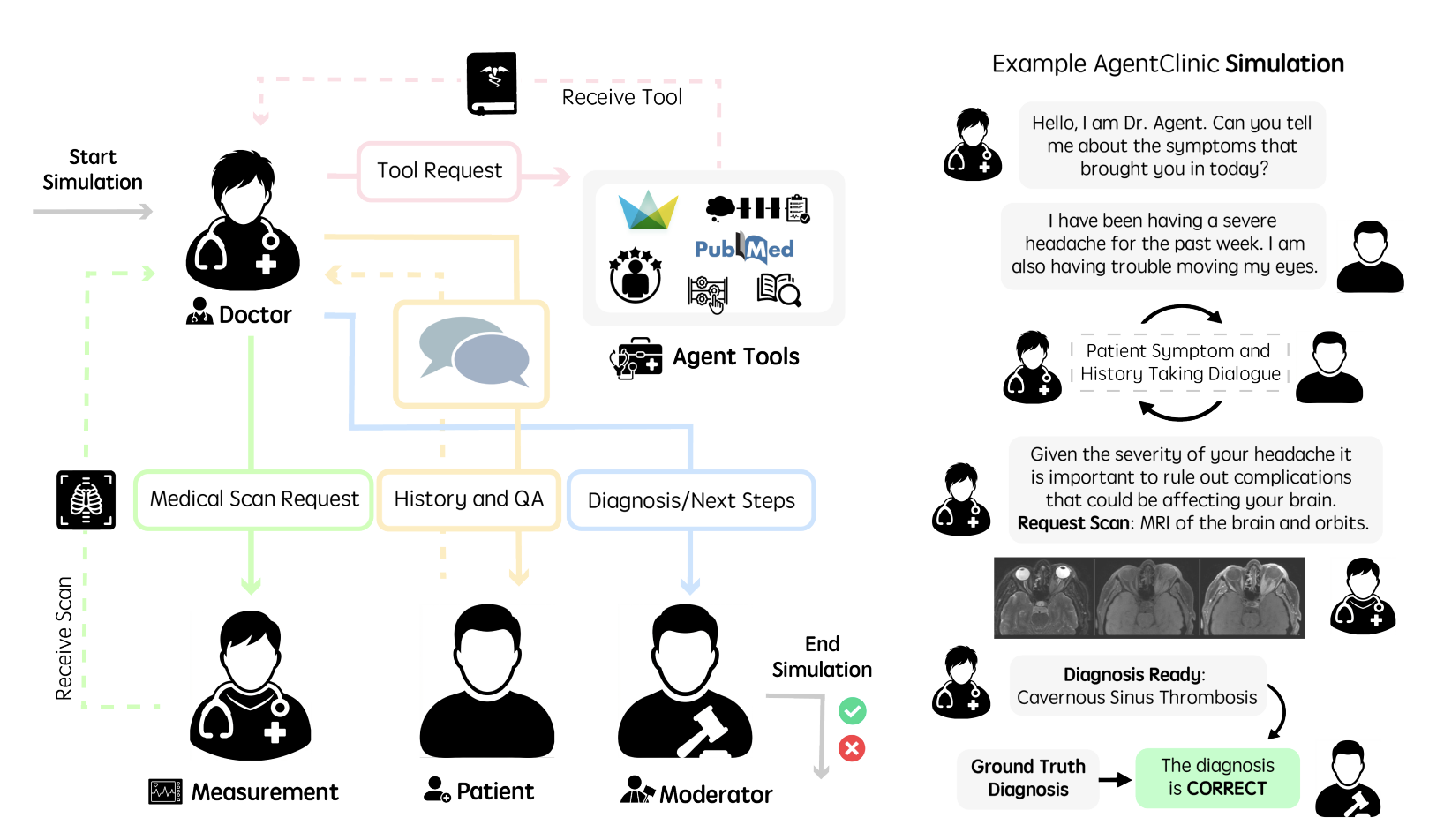
To properly measure how models handle the friction of real medicine, AgentClinic simulates a clinical encounter using four interacting agents: a doctor, a patient, a measurement agent, and a moderator. The doctor agent cannot just guess; it has to actively take a history, request scans, and interpret multimodal data to reach a diagnosis.
This represents a massive shift toward evaluating AI in the messy, incomplete-data environments where real clinical work happens.
Key Features of the AgentClinic Benchmark
- Sequential Decision-Making: Forces the AI to navigate patient interactions and gather incomplete data over time rather than feeding it a pre-packaged prompt.
- Multi-Agent Ecosystem: Proves that in an interactive simulation, the specific LLM used to play the role of the “patient” significantly impacts the doctor agent’s ultimate performance.
- Real-World Tool Augmentation: Equips doctor agents with functional tools like experiential learning, adaptive retrieval, reflection cycles, and persistent notebooks.
- Bias Perturbation: Injects 24 different cognitive biases (like confirmation or recency bias) and implicit biases (like gender or socioeconomic bias) to measure how realistic human flaws crash diagnostic accuracy and patient compliance.
- Multimodal & Multilingual Scale: Evaluates text and medical image interpretation (including radiology, pathology, and dermatology) across nine different medical specialties and seven languages.
The Engineering Takeaways
When building multi-agent architectures for health management, the choice of the underlying execution layer and the tools you provide changes everything. In these clinical simulations, Claude-3.5 Sonnet achieved the highest diagnostic accuracy across most settings, performing comparably to human physicians.
However, tool integration effectiveness varies dramatically depending on the model. For example, Llama-3 demonstrated up to a 92% relative improvement simply by being given a “notebook” tool that allowed it to write and edit notes that persisted across different cases.
Furthermore, when evaluating AI on complex, real-world multimodal cases (such as those from the New England Journal of Medicine), all models showed notably lower accuracy compared to text-only text-only settings.
If we want to build autonomous systems that genuinely assist in a clinic, we have to stop testing them like they are cramming for a written exam and start testing them in the interactive, tool-driven environments they will actually operate in.
BibTeX
@article{schmidgall2026agentclinic,
title={AgentClinic: a multimodal benchmark for tool-using clinical AI agents},
author={Schmidgall, Samuel and Ziaei, Rojin and Harris, Carl and Kim, Ji Woong and Reis, Eduardo Pontes and Jopling, Jeffrey and Moor, Michael},
journal={npj Digital Medicine},
year={2026},
publisher={Nature Publishing Group},
doi={10.1038/s41746-026-02674-7},
url={https://www.nature.com/articles/s41746-026-02674-7}
}