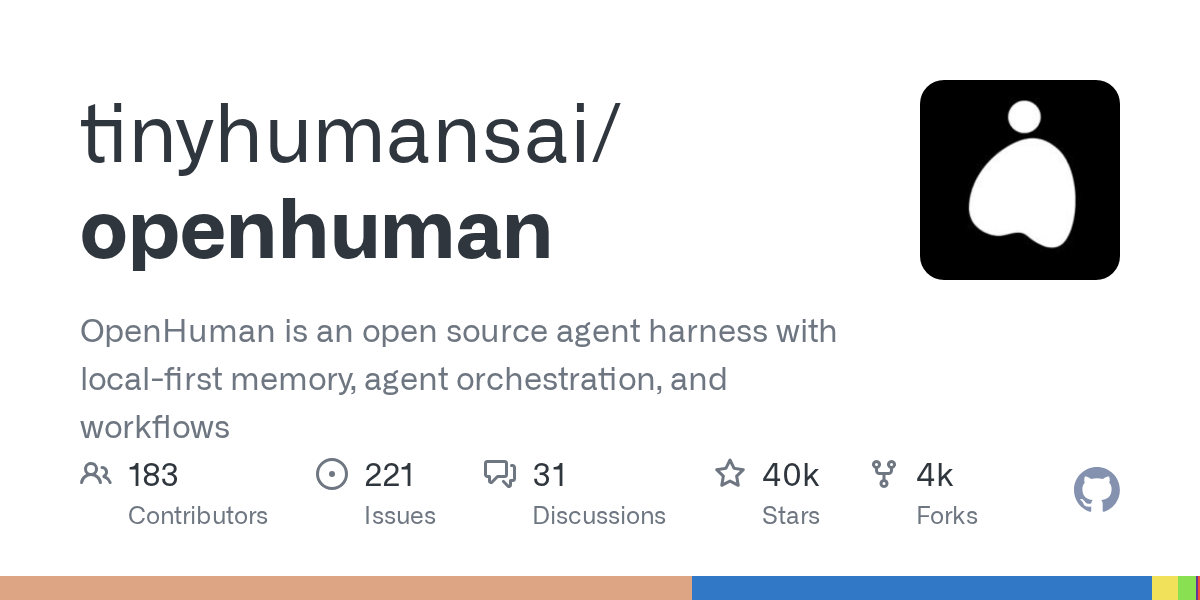
I’ve spent the last months watching AI tooling bloat into unmanageable daemons that eat RAM for breakfast and require a PhD in Kubernetes just to get a “hello world” running. So, here I decided to replace most of the AI Agents with this cool one, OpenHuman.
OpenHuman, The Agent!
OpenHuman is an open-source AI harness built with a Rust core that is lightweight, modular, and pluggable into whatever LLM, memory, or search engine you already run. It’s not just another chat interface; it’s a structural shift in how we think about agent density and runtime efficiency.
The creator, Sena Makel, and the team at Tiny Humans AI have engineered something that feels less like a framework and more like a precision instrument.
Within one week of its launch, it became the number one trending repository on GitHub for nine days in a row, and after diving into the codebase and benchmarks, I completely understand why.
Why OpenHuman?
What makes OpenHuman different is its architectural honesty. The core runs in-process, not as a separate daemon the UI talks to over a socket. This isn’t a minor detail; it’s a massive performance unlock. In their fleet sweeps, running 500 live agents in one process settled at a total of 1,393 MiB, whereas running those same 500 agents as separate processes would cost about 48 MiB per instance. Sharing one process is roughly 25 times denser.
For developers like me who care about resource-constrained environments and local-first infrastructure, this means thousands of agents on one box is no longer a theoretical dream, it’s a direction we can actually head toward.
A cold agent turn takes just 102 ms, and the full nine-phase bootstrap takes under half a second. That speed matters when you’re building real-time automation loops.
Modular Structure!
The modularity is where OpenHuman truly shines for serious developers. Cargo feature gates control exactly what compiles in. You can drop everything to get a pure-slim build at 51 MiB stripped, or add back skills and flows for a recommended 60 MiB recipe.
This level of control is rare in the AI space, where “batteries included” usually means “bloat included.” The capability comes from loadable native modules like tinydocs, tinyvoice, tinyjuice (for token compression), and tinymcp. Each module has a small bus contract crate, ensuring that the system remains extensible without becoming fragile.
We are particularly excited about the pluggable engines. OpenHuman doesn’t lock you into a specific provider. You can route through Ollama, LM Studio, MLX, or any local OpenAI-compatible server. It supports 26 bring-your-own-key providers, including Anthropic, Google, Groq, and DeepSeek.
For memory, it defaults to Memory Trees on TinyCortex, mirrored as an Obsidian vault on your machine, which aligns perfectly with our preference for local-first, privacy-focused data storage. The shared tinymemory contract already ships adapters for six remote engines, giving us the flexibility to scale if needed while keeping our default posture secure and local.
Jev; The Decision Model
One of the most clever features is Jev, a small decision model that runs through the TinyHumans System One proxy. Not every decision needs a large language model to generate prose. Jev takes a question and a fixed set of options and returns a calibrated probability for each. It’s incredibly efficient for tool search. In tests with 215 core tools and 1,000 Composio actions, letting Jev choose among top candidates got the right tool 62% of the time, compared to 22.5% for plain BM25 retrieval. It drives step-by-step decisions inside the browser tool, ensuring that consequential actions like purchases or deletes return a NeedsConfirmation flag rather than executing blindly.
This adds a layer of safety and precision that raw LLM outputs often lack.
Automation
For automation, OpenHuman uses tinyflows, an open-source engine that lets you build saved, typed automation graphs. The agent proposes the workflow, you review it on a canvas, and save it. It’s the difference between wiring nodes by hand in n8n and describing what you want in natural language. With 22 node kinds including agent calls, HTTP requests, conditions, and loops, it handles complex task automation without the visual clutter.
We are deploying OpenHuman across our machines, browser, and terminal environments. The Tauri v2 desktop app works seamlessly on Windows, macOS, and Linux, while the identical SPA runs in any browser. For those of us who live in the terminal, the ratatui-based client is a joy to use.
But the real power for developers is the openhuman-embed library. It’s a typed facade for embedding the core directly in another Rust process, allowing one Runtime per process with any number of independent Agents. Each agent can have its own provider, access tier, working directory, MCP servers, and sandbox.
As a medical doctor and developer, I value engineering validation over legal contracts for protecting data. OpenHuman’s local-first, Rust-native compilation offers the compile-time security checks and path isolation I need. It doesn’t require accounts, API keys, or cloud services for its core functionality, making it a self-contained, downloadable application that respects user privacy.
We are using it now to build compliance engines and automate complex healthcare workflows, and it’s holding up beautifully under the strict efficiency and security standards we demand. If you’re tired of fragile, heavy AI tools and want something that respects your hardware and your intelligence, give OpenHuman a look. It’s not just cool; it’s necessary.